AI Calling vs Traditional Call Centers: Which Is Better for Growing Businesses?
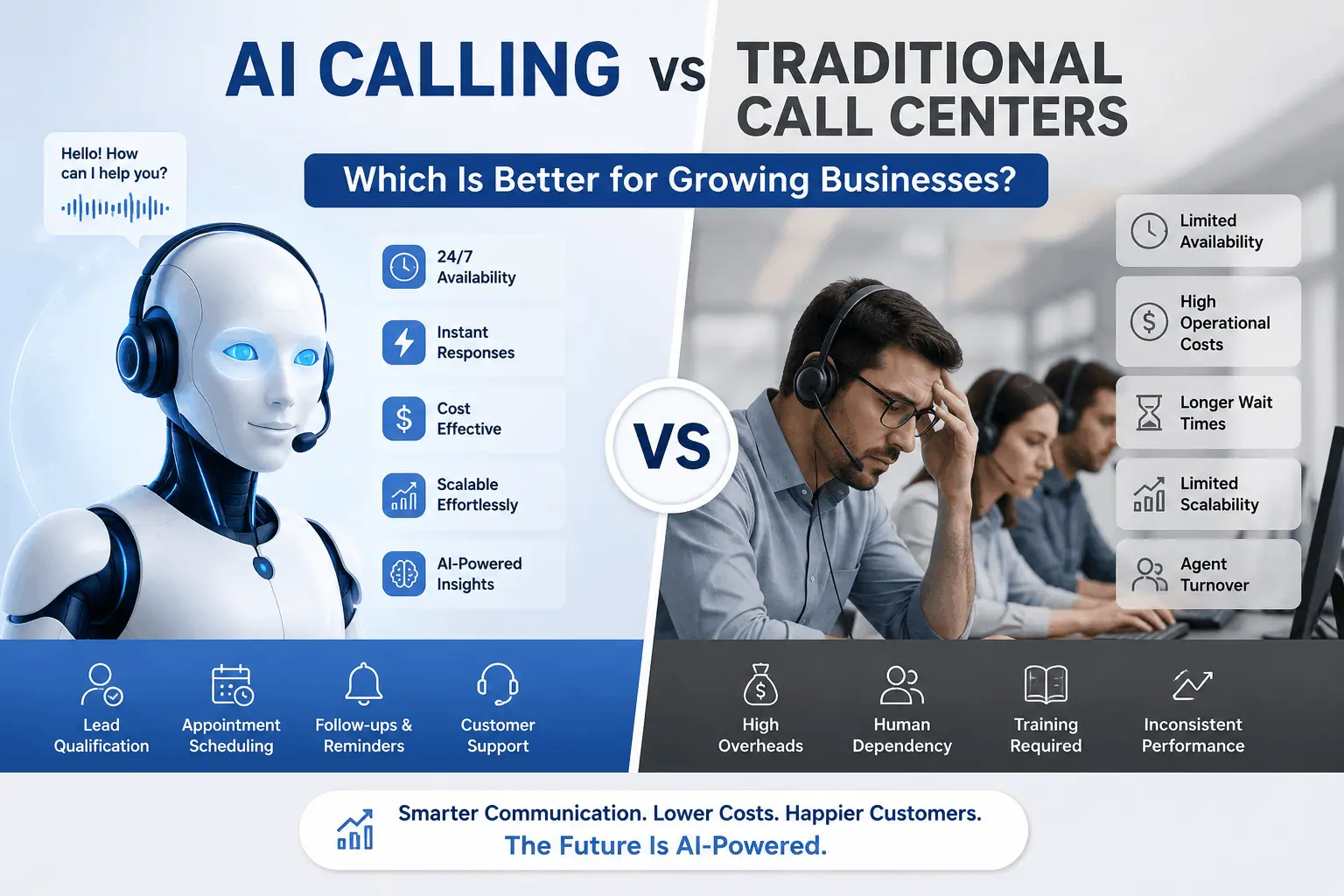
Customer communication plays a critical role in business growth. Whether it's generating leads, qualifying prospects, providing customer support, or scheduling appointments, businesses rely heavily on phone interactions to build relationships and drive revenue.
For decades, traditional call centers have been the standard solution for handling customer calls. However, advancements in Artificial Intelligence (AI) are transforming the way businesses communicate. AI-powered calling systems can now answer calls, qualify leads, schedule appointments, and provide customer support without requiring human intervention.
As businesses look for more efficient and scalable communication solutions, the question becomes:
Should you continue relying on traditional call centers, or is AI calling the better choice?
Let's compare both approaches and determine which solution is best suited for growing businesses.
Table Of Contents
- Executive Summary (TL; DR)
- What Is a Traditional Call Center?
- What Is AI Calling?
- AI Calling vs Traditional Call Centers: Key Comparison
- When Traditional Call Centers Still Make Sense
- The Best Approach: Combining AI and Human Agents
- How Pronnel Helps Businesses Modernize Customer Communication
- Future of Customer Communication
- FAQ’s
- Conclusion
Executive Summary (TL; DR) :
Businesses today face increasing pressure to provide faster, more efficient, and highly personalized customer communication. Traditionally, call centers have been the primary solution for handling customer support, sales inquiries, and lead management. While human agents offer empathy and problem-solving capabilities, traditional call centers often struggle with high operational costs, limited availability, and scalability challenges.
AI Calling is emerging as a powerful alternative that enables businesses to automate inbound and outbound phone conversations using intelligent voice agents. These systems can answer customer inquiries, qualify leads, schedule appointments, conduct follow-ups, and route calls without human intervention. AI-powered calling solutions operate 24/7, reduce response times, and allow businesses to manage large call volumes without significantly increasing costs.
This article compares AI Calling and Traditional Call Centers across key factors such as cost efficiency, scalability, customer experience, availability, and sales productivity. While traditional call centers remain valuable for handling complex and emotionally sensitive interactions, AI Calling excels at automating repetitive tasks and improving operational efficiency.
For growing businesses, the most effective approach is often a hybrid model that combines AI automation with human expertise. By leveraging AI for routine interactions and human agents for complex conversations, organizations can enhance customer satisfaction, improve team productivity, and reduce operational expenses.
Platforms like Pronnel help businesses implement this modern communication strategy by integrating AI Calling, CRM, lead management, appointment scheduling, and omnichannel engagement into a single unified workspace.
What Is a Traditional Call Center?
A traditional call center consists of human agents who handle inbound and outbound customer communications.
Common responsibilities include:
- Customer support
- Sales calls
- Lead qualification
- Appointment scheduling
- Technical assistance
- Customer follow-ups
Traditional call centers can be operated in-house or outsourced to third-party service providers.
While human agents bring empathy and problem-solving skills, traditional call centers often face challenges related to staffing, operational costs, and scalability.
What Is AI Calling?
AI Calling uses artificial intelligence and voice automation technologies to interact with customers through phone calls.
Modern AI voice agents can:
- Answer inbound calls
- Make outbound calls
- Qualify leads automatically
- Schedule appointments
- Collect customer information
- Send follow-up notifications
- Route calls to the appropriate department
- Provide instant responses to common questions
Unlike traditional call centers, AI calling systems can operate continuously without requiring breaks, shifts, or additional staffing.
AI Calling vs Traditional Call Centers: Key Comparison
1. Cost Efficiency
Traditional Call Centers
Operating a call center requires significant investment in:
- Hiring agents
- Employee training
- Salaries and benefits
- Office infrastructure
- Management and supervision
As call volume increases, businesses often need to hire more staff, increasing operational expenses.
AI Calling
AI voice agents can handle thousands of calls simultaneously without increasing staffing costs.
Benefits include:
- Lower operational expenses
- Reduced hiring costs
- Minimal training requirements
- Faster scalability
Winner: AI Calling
2. Availability
Traditional Call Centers
Most call centers operate during specific business hours.
Challenges include:
- Limited availability
- After-hours inquiries
- Holiday and weekend coverage
Customers often experience delays when contacting businesses outside operating hours.
AI Calling
AI-powered calling systems are available:
- 24/7
- Weekends
- Holidays
- Peak traffic periods
This ensures customers always receive immediate assistance.
Winner: AI Calling
3. Scalability
Traditional Call Centers
Scaling requires:
- Recruiting new agents
- Training employees
- Expanding infrastructure
This process can take weeks or even months.
AI Calling
AI systems can instantly manage increased call volumes without additional staffing.
Businesses can scale customer communication during:
- Marketing campaigns
- Seasonal demand spikes
- Product launches
- Business expansion
Winner: AI Calling
4. Customer Experience
Traditional Call Centers
Human agents provide:
- Empathy
- Emotional understandin
- Complex problem-solving
- Personalized interactions
For sensitive or complicated situations, human communication remains valuable.
AI Calling
Modern AI voice agents offer:
- Faster responses
- Consistent service quality
- Reduced wait times
- Instant information retrieval
However, highly complex situations may still require human intervention.
Winner: Depends on Use Case
5. Response Time
Traditional Call Centers
Customers often experience:
- Long hold times
- Call queues
- Delayed callbacks
High call volumes can negatively impact customer satisfaction.
AI Calling
AI systems answer calls instantly and can handle multiple conversations simultaneously.
Benefits include:
- No waiting time
- Faster issue resolution
- Improved customer satisfaction
Winner: AI Calling
6. Lead Qualification and Sales
Traditional Call Centers
Sales teams spend significant time:
- Contacting leads
- Gathering information
- Scheduling appointments
Many calls involve repetitive tasks that reduce productivity.
AI Calling
AI voice agents can:
- Contact leads instantly
- Ask qualifying questions
- Score prospects
- Schedule appointments automatically
Sales representatives can focus on high-value conversations and closing deals.
Winner: AI Calling
When Traditional Call Centers Still Make Sense
Although AI calling offers many advantages, traditional call centers remain useful for:
Complex Customer Issues
Situations requiring critical thinking, negotiation, or emotional support often benefit from human interaction.
High-Touch Enterprise Sales
Enterprise deals frequently require relationship building and personalized conversations.
Escalation Management
Human agents are essential when handling sensitive customer concerns or complaints.
The Best Approach: Combining AI and Human Agents
Rather than replacing human agents entirely, many growing businesses adopt a hybrid model.
AI handles:
- Initial customer inquiries
- Lead qualification
- Appointment scheduling
- Follow-up calls
- Frequently asked questions
Human agents focus on:
- Complex support requests
- High-value sales opportunities
- Relationship management
- Escalations
This combination improves efficiency while maintaining a personalized customer experience.
How Pronnel Helps Businesses Modernize Customer Communication
Pronnel combines AI Calling, CRM, and Omnichannel Communication into a single platform.
Businesses can:
- Automate inbound and outbound calls
- Qualify leads using AI voice agents
- Schedule appointments automatically
- Manage customer interactions from one dashboard
- Track conversations and customer history
- Improve sales and support efficiency
By integrating AI calling with CRM workflows, businesses can reduce manual effort while delivering faster and more consistent customer experiences.
Future of Customer Communication
As AI technology continues to evolve, businesses are moving toward intelligent communication systems that combine automation with human expertise.
AI calling is no longer a futuristic concept—it is becoming an essential tool for companies looking to:
- Increase productivity
- Reduce operational costs
- Improve customer satisfaction
- Scale customer engagement efficiently
Organizations that embrace AI-powered communication today will be better positioned to compete in the future.
Frequently Asked Questions About Frequently Asked Questions Top 10 AI Tools Every Sales Team
What is AI Calling?
AI Calling uses artificial intelligence and voice automation technologies to handle inbound and outbound phone calls, automate customer interactions, qualify leads, schedule appointments, and provide support.
How does AI Calling differ from traditional call centers?
Traditional call centers rely on human agents to manage customer interactions, while AI Calling uses intelligent voice agents to automate conversations, reduce response times, and operate continuously.
Is AI Calling more cost-effective than traditional call centers?
Yes. AI Calling reduces staffing, training, and operational costs while allowing businesses to handle large call volumes without increasing workforce requirements.
Can AI voice agents replace human call center agents?
AI voice agents can automate routine tasks such as answering common questions, lead qualification, and appointment scheduling. However, human agents are still valuable for complex issues and personalized interactions.
What are the benefits of AI Calling for growing businesses?
AI Calling helps businesses improve customer response times, reduce operational costs, increase scalability, automate repetitive tasks, and provide 24/7 customer support.
Can AI Calling handle inbound and outbound calls?
Yes. AI Calling solutions can answer inbound customer inquiries and make outbound calls for lead generation, follow-ups, reminders, surveys, and appointment confirmations.
Why do some businesses still use traditional call centers?
Traditional call centers are often preferred for handling sensitive customer concerns, complex problem-solving, enterprise sales discussions, and situations that require empathy and human judgment.
What is the best approach: AI Calling or traditional call centers?
Many businesses achieve the best results with a hybrid approach, using AI Calling to automate repetitive tasks while allowing human agents to focus on high-value customer interactions.
Can AI Calling integrate with CRM software?
Yes. Modern AI Calling platforms integrate with CRM systems to automatically log calls, update customer records, track interactions, and streamline sales and support workflows.
How does Pronnel help businesses with AI Calling?
Pronnel combines AI Calling, CRM, lead management, appointment scheduling, and omnichannel communication into a unified platform, helping businesses automate customer engagement and improve operational efficiency.
Conclusion
When comparing AI Calling and Traditional Call Centers, the right choice depends on your business goals. Traditional call centers offer human empathy and personalized interactions, while AI calling delivers speed, scalability, cost savings, and 24/7 availability. For most growing businesses, a hybrid approach provides the best results—using AI to automate repetitive tasks while allowing human agents to handle complex interactions. With platforms like Pronnel, businesses can combine AI voice automation, CRM, and omnichannel communication to create a smarter, more efficient customer engagement strategy. The future of customer communication isn't AI versus humans—it's AI and humans working together to deliver exceptional customer experiences.
Subscribe To Pronnel Blogs
Get the latest updates on AI CRM software, WhatsApp automation, business productivity, customer engagement, and workflow automation directly to your inbox.