Why AI-Powered CRM Software Is Essential for Growing Businesses in 2026
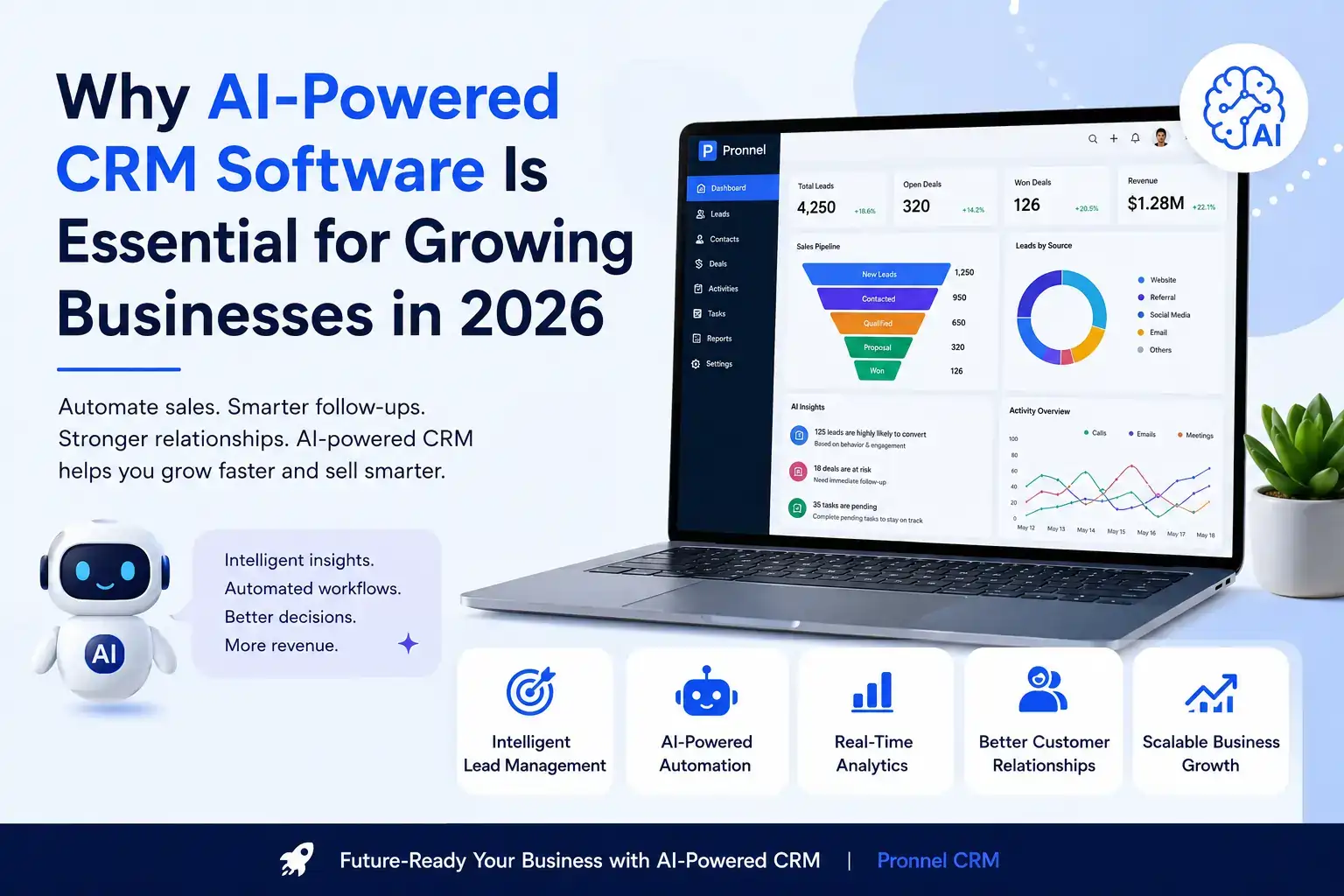
Customer expectations have changed dramatically over the last few years. Prospects expect instant responses, personalized communication, and seamless experiences across every touchpoint. At the same time, businesses are generating more leads, managing larger customer databases, and handling increasingly complex sales processes. Yet many growing companies still rely on spreadsheets, disconnected communication channels, and manual workflows to manage customer relationships. This creates operational bottlenecks, slows down sales teams, and causes valuable opportunities to slip through the cracks.
In this comprehensive guide, we'll explore why AI-powered CRM software has become a necessity rather than a luxury in 2026. We'll examine the limitations of traditional customer management methods, uncover the key benefits of AI-driven CRM systems, and explain how businesses can use intelligent automation to accelerate growth, improve customer satisfaction, and increase revenue.
Table Of Contents
- Executive Summary (TL; DR)
- Why Traditional CRM Systems Are No Longer Enough
- Understanding AI-Powered CRM Software
- 10 Reasons Growing Businesses Need AI CRM in 2026
- How Pronnel Helps Businesses Leverage AI CRM
- 5 Best Practices for Successful CRM Implementation
- FAQ’s
- Conclusion
Executive Summary (TL; DR) :
Following the rapid adoption of automation, artificial intelligence, and digital-first customer engagement strategies, businesses can no longer afford to manage customer relationships using outdated methods. Traditional CRM systems often require extensive manual effort, resulting in delayed responses, missed follow-ups, and poor visibility into customer interactions.
This guide explores how AI-powered CRM software transforms customer relationship management through intelligent automation, predictive analytics, lead scoring, workflow automation, and real-time reporting.
🚀 Growth Accelerator: Stop managing leads through spreadsheets and disconnected tools. Upgrade to a unified AI-powered workspace with Pronnel CRM to automate lead management, customer communications, sales tracking, and team collaboration from a single platform.Free Omnichannel Lead Management Workspace via Pronnel.
We'll break down the ten most important reasons businesses are investing in AI CRM software in 2026 and explain how organizations can build scalable sales and customer management processes that support long-term growth.
Why Traditional CRM Systems Are No Longer Enough
When businesses first begin acquiring customers, managing leads through spreadsheets and basic databases may seem sufficient. However, as customer volumes increase, these manual systems quickly become difficult to maintain.
Growing Customer Data Complexity
Every customer interaction generates valuable data including emails, phone calls, meeting notes, website activity, social media conversations, and support requests. Managing this information manually becomes increasingly challenging. Without centralized visibility, sales teams struggle to understand customer history and provide personalized experiences.
Delayed Lead Response Times
Modern buyers expect immediate responses. Studies consistently show that businesses responding quickly to inquiries significantly increase their chances of converting prospects into customers. Manual lead assignment processes often create delays that result in lost opportunities.
Lack of Actionable Insights
- High-value leads
- Cold prospects
- Pipeline bottlenecks
- Sales performance trends
- Customer engagement patterns
Without these insights, decision-making becomes reactive rather than proactive.
Increased Administrative Work
Sales representatives frequently spend hours updating records, creating reports, and managing repetitive administrative tasks. This reduces the time available for customer conversations and revenue-generating activities. The solution lies in leveraging artificial intelligence to automate repetitive processes and transform raw data into actionable business intelligence.
Understanding AI-Powered CRM Software
AI-powered CRM software combines traditional customer relationship management capabilities with artificial intelligence technologies to create smarter, more efficient workflows.
Unlike conventional CRM platforms, AI-driven systems can:
- Automatically prioritize leads
- Predict customer behavior
- Recommend next actions
- Automate follow-ups
- Generate performance insights
- Improve forecasting accuracy
- Enhance customer engagement
By analyzing large volumes of customer data, AI helps businesses make better decisions while reducing manual workload. Instead of simply storing customer information, AI CRM actively assists teams in improving sales performance and customer experiences.
10 Reasons Growing Businesses Need AI CRM in 2026
1. Faster Lead Response Times
In today's competitive marketplace, speed matters. Prospects often contact multiple vendors before making a decision. Businesses that respond first frequently gain a significant advantage.
The Solution: AI-powered lead routing automatically assigns inquiries to available sales representatives based on predefined rules.
This ensures every lead receives prompt attention.
2. Smarter Lead Qualification
Not every lead has the same likelihood of converting.
AI analyzes customer behavior, engagement history, demographic information, and previous interactions to identify high-potential prospects.
The Solution: Automated lead scoring enables sales teams to prioritize opportunities most likely to generate revenue.
3. Automated Follow-Up Management
One of the biggest causes of lost revenue is inconsistent follow-up.
Prospects often require multiple touchpoints before making purchasing decisions.
The Solution: AI-driven reminders and automated workflows ensure that no opportunity is forgotten.
4. Improved Sales Forecasting
Accurate forecasting helps businesses plan resources, budgets, and growth strategies more effectively.
Traditional forecasting methods often rely on assumptions and incomplete information.
The Solution: AI analyzes historical performance, pipeline activity, and customer behavior to generate more reliable revenue forecasts.
5. Increased Sales Productivity
Sales teams should spend their time building relationships and closing deals—not updating spreadsheets.
The Solution: AI automates repetitive administrative tasks, allowing representatives to focus on high-value activities.
6. Better Customer Experiences
Customers expect personalized interactions throughout their journey.
AI helps businesses understand customer preferences and engagement patterns.
The Solution: Deliver targeted communication and personalized recommendations based on customer behavior.
7. Real-Time Reporting and Analytics
Business leaders require immediate visibility into performance metrics.
Waiting for manually generated reports slows decision-making.
The Solution: AI-powered dashboards provide instant access to key performance indicators and operational insights.
8. Omnichannel Customer Communication
Customers engage through multiple channels including:
- Phone Calls
- Social Media
- Website Forms
Managing these channels separately creates communication gaps.
The Solution: AI CRM platforms consolidate customer conversations into a unified workspace.
9. Workflow Automation
Manual processes often introduce delays and inconsistencies.
Routine tasks such as lead assignment, follow-up scheduling, and status updates consume valuable resources.
The Solution: Workflow automation eliminates repetitive tasks while improving operational consistency.
10. Scalable Business Growth
As organizations grow, manual systems become increasingly difficult to manage.
Businesses require scalable infrastructure that supports expansion.
The Solution: AI-powered CRM software enables teams to handle larger customer volumes without significantly increasing administrative overhead.
How Pronnel Helps Businesses Leverage AI CRM
Growing businesses need more than just a contact database. They need a unified workspace that combines customer management, communication tracking, automation, collaboration, and analytics.
Pronnel helps organizations eliminate operational inefficiencies through a centralized AI-powered platform.
Key capabilities include:
- Lead Management
- Contact Management
- Activity Tracking
- Sales Pipeline Management
- Workflow Automation
- Omnichannel Communication
- Task Scheduling
- Reporting and Analytics
- Team Collaboration
- Customer Journey Tracking
Instead of juggling multiple disconnected applications, businesses can manage their entire customer lifecycle from a single platform.
5 Best Practices for Successful CRM Implementation
1. Centralize All Customer Data
Ensure all customer interactions are stored within a single system.
2. Automate Repetitive Processes
Identify manual tasks that can be streamlined through automation.
3. Train Teams Consistently
Provide ongoing training to maximize CRM adoption and utilization.
4. Monitor Performance Metrics
Track key indicators such as conversion rates, response times, and customer retention.
5. Continuously Optimize Workflows
Regularly review processes and identify opportunities for improvement.
Frequently Asked Questions About Frequently Asked Questions About AI powered software
What is AI-powered CRM software?
AI-powered CRM software combines traditional customer relationship management capabilities with artificial intelligence technologies to automate tasks, analyze customer data, predict customer behavior, and improve sales and customer service performance.
How does AI improve lead management?
AI helps businesses automatically score, prioritize, and route leads based on engagement levels, customer behavior, and conversion probability. This allows sales teams to focus on high-value prospects and improve conversion rates.
Why do growing businesses need AI CRM software in 2026?
Growing businesses face increasing customer expectations, larger volumes of customer data, and more complex sales processes. AI CRM software helps automate workflows, improve productivity, deliver personalized customer experiences, and support scalable business growth.
Can AI-powered CRM automate follow-ups with leads?
Yes. AI CRM systems can automatically schedule follow-ups, send reminders, trigger email sequences, and notify sales representatives when prospects require attention, ensuring no opportunities are missed.
What are the main benefits of AI-powered CRM software?
Key benefits include faster lead response times, intelligent lead scoring, workflow automation, improved sales forecasting, real-time analytics, enhanced customer experiences, and increased team productivity.
Which industries can benefit from AI CRM software?
AI CRM software is beneficial for industries such as real estate, healthcare, education, finance, manufacturing, technology, professional services, and any business that manages customer relationships and sales processes.
How does Pronnel help businesses leverage AI-powered CRM?
Pronnel provides a unified platform for lead management, contact management, activity tracking, sales pipeline management, workflow automation, omnichannel communications, reporting, analytics, and team collaboration, helping businesses streamline operations and accelerate growth.
Conclusion
Businesses that continue relying on spreadsheets and manual customer management processes will struggle to meet the expectations of modern buyers. As customer interactions become increasingly complex, organizations require smarter tools that can automate routine tasks, improve visibility, and support data-driven decision-making. AI-powered CRM software provides the foundation for scalable growth by helping businesses manage leads more effectively, improve customer engagement, and streamline sales operations. By combining intelligent automation, predictive insights, workflow management, and real-time analytics, platforms like Pronnel empower businesses to deliver exceptional customer experiences while increasing operational efficiency. Organizations that embrace AI-driven customer relationship management today will be better positioned to compete, innovate, and grow throughout 2026 and beyond.
Subscribe To Pronnel Blogs
Get the latest updates on AI CRM software, WhatsApp automation, business productivity, customer engagement, and workflow automation directly to your inbox.