10 Reasons Your Sales Pipeline is Leaking Money (And How to Fix It Without Excel)
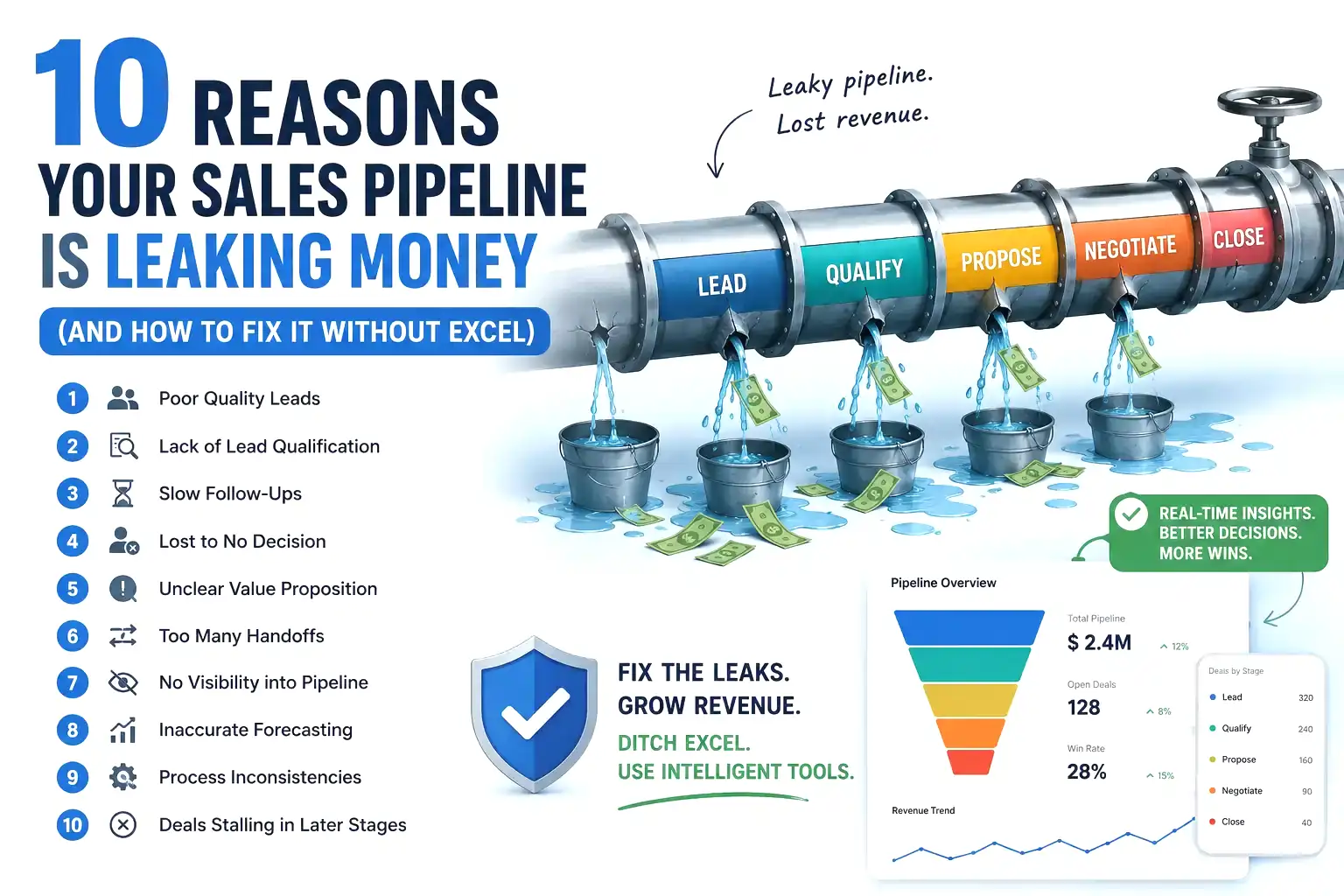
You are spending thousands on performance marketing campaigns to fill the top of your funnel with high-quality leads. But if your internal sales operations are fractured, that hard-earned traffic is dropping through the floorboards before ever turning into closed-won revenue. Relying on manual spreadsheets, broken communication loops, and siloed software means you are running a leaking funnel. In this comprehensive guide, we uncover the top 10 hidden friction points draining your conversions and provide an actionable blueprint to patch them up for good.
Table Of Contents
- Executive Summary (TL; DR)
- The Fatal Flaw of Spreadsheet-Based Pipelines
- 10 Pipeline Leaks Draining Your Revenue (And Their Fixes)
- The Ultimate Blueprint: Patching Leaks Natively with Pronnel
- 5 Golden Rules for Ongoing Pipeline Optimization
- FAQ’s
Executive Summary: Manual Processes vs. Systemic Pipeline Automation
Following up from our look at deep operational data architectures in How to Track Your Marketing Performance, this post focuses squarely on the execution side of your conversions. Even a mathematically sound multi-touch attribution roadmap cannot save a company if sales reps fail to nurture inbound opportunities systematically.
This guide highlights the 10 structural mistakes causing pipeline data leakages—including delayed response times, platform friction, poor qualification, and missed follow-ups. We shift your sales infrastructure away from fragile Microsoft Excel spreadsheets into an agile workflow setup.
🚀 Operational Efficiency Drive: Stop hacking together disparate tools. Transition your business from manual spreadsheets to an integrated, AI-first ecosystem with a Free Omnichannel Lead Management Workspace via Pronnel.
We detail how marrying multi-channel message aggregation (WhatsApp, Social Media, Email) with clear task assignment prevents prospective buyers from abandoning your sales cycle mid-funnel. We wrap things up with 5 core management principles to protect your sales velocity and ensure a high return on your performance advertising outlays.
The Fatal Flaw of Spreadsheet-Based Pipelines
When starting an enterprise, managing your initial leads inside Microsoft Excel or Google Sheets feels natural. But as ad spends grow, reliance on spreadsheets becomes a major operational bottleneck. Manual entry introduces immediate problems:
- Zero Contextual Communication Tracking: Spreadsheets cannot natively ingest call recordings, WhatsApp logs, or long email threads under a single row.
- Delayed Lead Speed-to-Lead: Copying inbound web contacts across platforms wastes hours, killing critical contact speed.
- Security Risks: Static document sheets can be downloaded with a single click, putting valuable client lists at risk of being misplaced or stolen.
To scale smoothly, your sales data must update dynamically. If it doesn't, your pipelines will fail to keep pace with modern customer demand.
10 Pipeline Leaks Draining Your Revenue (And Their Fixes)
1. Slow Response Speed-to-Lead Times
Inbound leads lose interest fast. If an interested visitor fills out a request form on your landing asset and waits over an hour for a reply, your chance of converting them drops sharply.
The Fix: Replace static landing pages with direct API routing pipelines that instantly map incoming contacts to on-duty sales reps via automated round-robin notifications.
2. Disconnected Communication Silos
When agents use personal WhatsApp profiles, work email boxes, and private phones, data slips through the cracks. If a rep goes on leave or leaves the company, their deal histories vanish with them.
The Fix: Use a unified omnichannel customer inbox that records all text, chat, and call histories into shared, transparent team views.
3. Weak Lead Qualification Criteria
Forcing high-value sales executives to pitch unverified or low-budget contacts wastes time and energy. This leaves high-intent, qualified accounts waiting in backlogs.
The Fix: Build structural scoring check-boxes using established qualification matrices (like BANT or GPCTBA) straight into your early-stage routing pipelines.
4. Dropped Multi-Stage Follow-Ups
Most complex B2B deals require multiple touchpoints over several months to close. When sales reps rely on basic memory or manual reminder flags, complex nurturing processes quickly fall apart.
The Fix: Build systematic follow-up reminder rules that automatically prompt active reps when a prospect goes quiet for a set period.
5. Lack of Deal Accountability and Ownership
When inbound leads are dumped into general team inboxes without a clear single owner, deals stall out as team members assume someone else is handling it.
The Fix: Force clear user ownership for every new ticket, ensuring each account has an explicitly assigned representative from start to finish.
6. Content Silos and Missing Collateral
Sales reps lose valuable momentum when they have to stop a call to hunt through Google Drive or internal message chats for the latest product brochures, case studies, or price sheets.
The Fix: Centralize your core content repositories directly inside your primary sales workspace for instant access during live pitches.
7. Poor Tracking of Offline Sales Actions
For companies with extended negotiation cycles, field visits, and offline contract sign-offs, web analytics platforms like GA4 fail to track key mid-funnel milestones.
The Fix: Track distinct pipeline progression steps (e.g., Demo Scheduled, Proposal Sent, Under Review) manually or programmatically within an enterprise tracker.
8. Inefficient Meeting and Calendar Management
Playing phone tag or sending long email threads back and forth just to book a simple product demonstration introduces friction that can scare off busy prospective buyers.
The Fix: Use direct appointment booking page widgets to let incoming prospects select open calendar slots instantly.
9. Broken Handoffs Between Marketing, Sales, and Support
When an account moves from a marketing lead to a qualified sales prospect, or from a closed deal to client onboarding, data gaps create a frustrating customer experience.
The Fix: Move your workflows into a unified customer platform so operations, customer support, and sales teams all share the exact same contextual data timeline.
10. Blind Management Decisions and Hidden Drop-off Spots
Without clear funnel dashboards, company leaders cannot pinpoint exactly where prospects are falling out of the buying cycle, making it impossible to fix underlying conversion issues.
The Fix: Track visual conversion funnels to identify where deals are stalling out and focus your optimization efforts on those specific friction points.
The Ultimate Blueprint: Patching Leaks Natively with Pronnel
Fixing these ten pipeline leakages doesn't require purchasing ten different software tools. Connecting independent single-feature applications creates data silos and integration issues. Instead, look to a unified operations suite.

Moving your operations into Pronnel instantly eliminates these tracking gaps through native, built-in features:
- Omnichannel Customer Inbox: Unify WhatsApp Business, Instagram, Telegram, and Email threads into a single shared inbox to ensure no customer message is missed.
- Native SIP & AI Voice Calling: Make outbound calls directly inside your workspace browser view, with automated call recording logs mapped to the customer profile.
- Integrated Project Management Task Boards: Easily hand off closed deals to your customer support or implementation engineering squads without losing context.
- Built-in Calendars and Schedulers: Eliminate external scheduling tools by utilizing native booking pages that sync seamlessly across your corporate accounts.
5 Golden Rules for Ongoing Pipeline Optimization
1. Automate Early-Stage Ingestions
Do not allow manual transcription at the top of your funnel. Protect lead freshness by ensuring all inbound web channels feed automatically into your core workspace.
2. Enforce absolute Workspace Cleanliness
If a sales interaction isn't logged inside your shared platform, it didn't happen. Keeping clean records prevents overlapping follow-ups and keeps customer data accurate.
3. Keep an Eye on Pipeline Velocity Metrics
Track the average number of days an account spends stuck in individual pipeline stages. Spotting these slow-downs helps you address process bottlenecks before they hurt revenue.
4. Audit Your Lead Distribution Logic
Regularly update your lead-routing rules to ensure hot inbound inquiries are sent directly to your best-performing, active sales reps.
5. Clean Out Stale Leads Systematically
Do not let dead opportunities clutter your active sales boards. Move cold prospects into long-term marketing re-engagement tracks to keep your sales focus sharp.
In the upcoming parts of this operations optimization series, we will break down effective workflow design patterns for complex B2B pipelines and dive into field service tracking models. We will also analyze real-world case studies of growing teams that cut software costs by consolidating their technical stacks.
Frequently Asked Questions About Frequently Asked Questions About Sales Pipeline Optimization
What is the difference between a sales funnel and a sales pipeline?
A sales funnel measures conversion percentages from the perspective of the customer journey (Awareness to Decision), while a sales pipeline reflects the internal operational actions taken by your sales reps to progress a lead from initial contact to a closed-won deal.
Why are spreadsheets like Excel bad for tracking an enterprise sales pipeline?
Spreadsheets are static, manual, and prone to human error. They lack automatic tracking for communication histories (like email or WhatsApp logs), fail to provide real-time notification alerts for rapid lead routing, and present a massive data security risk.
What is speed-to-lead and why does it affect my revenue?
Speed-to-lead is the time it takes for a sales representative to respond to an inbound inquiry. B2B prospects are highly likely to buy from the vendor that responds first; delaying your outreach by even an hour causes a massive drop in conversion rates.
How can a business track offline sales milestones inside a digital pipeline?
By utilizing an integrated lead management CRM rather than relying solely on web analytics. A CRM allows sales reps to manually or programmatically update distinct deal stages (e.g., "Demo Completed", "Contract Under Review") for real-world interactions.
What is pipeline velocity and how is it measured?
Pipeline velocity measures the speed at which opportunities move through your sales cycle and generate revenue. It is calculated by multiplying the number of active deals by your average win rate and deal value, then dividing that total by your average sales cycle length in days.
How does an omnichannel customer inbox patch pipeline leaks?
It unifies all incoming chats from WhatsApp, Instagram, Telegram, and Email into a single, shared workspace dashboard. This prevents hot leads from slipping through the cracks when individual reps are on leave or juggling different apps.
Can Pronnel CRM help fix a leaking sales pipeline?
Yes. Pronnel CRM unifies lead tracking, omnichannel communications, outbound calling, and task management into an AI-driven platform, ensuring full data accountability, instant routing automation, and clear pipeline transparency.
Conclusion
Plugging the structural leaks in your sales pipeline is the fastest, most cost-effective path to scaling your bottom line without doubling your performance marketing ad budget. Your business does not necessarily need a higher volume of inbound traffic; it needs a disciplined system to capture, track, and convert the market interest it already has.
Relying on manual spreadsheets and isolated applications limits your operational visibility and slows your speed-to-lead execution. Transitioning your pipeline infrastructure into an automated, unified workspace guarantees data transparency, prevents lead drop-offs, and empowers your reps to follow up predictably.
Take absolute control of your lead pipelines, establish cross-departmental accountability across sales and marketing, and stop watching valid revenue opportunities fade away due to manual tracking gaps.
Pronnel helps businesses centralize lead management, customer journeys, pipeline automation, conversion analytics, and team collaboration from a single, high-efficiency platform.
Subscribe To Pronnel Blogs
Get the latest updates on AI CRM software, WhatsApp automation, business productivity, customer engagement, and workflow automation directly to your inbox.